
15 School Fundraising Ideas That Actually Raise Money in 2026
15 school fundraising ideas compared by effort, volunteer hours and typical raise, with a four-week launch plan, an FAQ and profit math.
The best school fundraiser is one your community will join, and your volunteers can manage. To make the options easier to compare, each idea below includes a planning estimate for the amount raised and the time involved. These ranges are not guarantees. Results depend on school size, participation, costs, and how the fundraiser is run.
Amounts are rough planning estimates, not promises. For events, focus on the net after expenses. For product fundraisers, check the profit share and any costs before setting your goal.
1. Walk-a-thon
Effort: High; roughly 25–60 volunteer hours · Best for: Schools with a strong student and family community · Typical raise: $3,000–$20,000+
Students walk laps or a set route while family and friends donate per lap or make a flat pledge. Set a clear school-wide goal and make it easy to donate online. This can bring in meaningful support, but plan for permissions, safety, volunteer coverage, and a rain date.
2. Read-a-thon
Effort: Low to medium; roughly 10–25 volunteer hours · Best for: Elementary schools, libraries, and literacy goals · Typical raise: $1,000–$10,000+
Students log reading time or pages, and supporters donate to encourage them. Online tracking keeps paperwork down, and the activity can fit into a few weeks without a large event day. Keep the focus on participation and reading, not only on which student raises the most.
3. Direct-ship online cookie fundraiser
Effort: Low to medium; roughly 4–10 organizer hours, plus sharing · Best for: Busy groups that want to reach supporters beyond the school neighborhood · Typical raise: $500–$10,000+
An online treat fundraiser gives students and families a simple storefront link to share. With Raise Cravings, powered by Baked Cravings, your group keeps 50% of product sales, with zero upfront fees and zero minimums. Orders ship straight to supporters’ doors nationwide, so volunteers do not have boxes to sort or deliver. Organizers can use the iOS or Android app or web dashboard to see real-time sales and leaderboards.
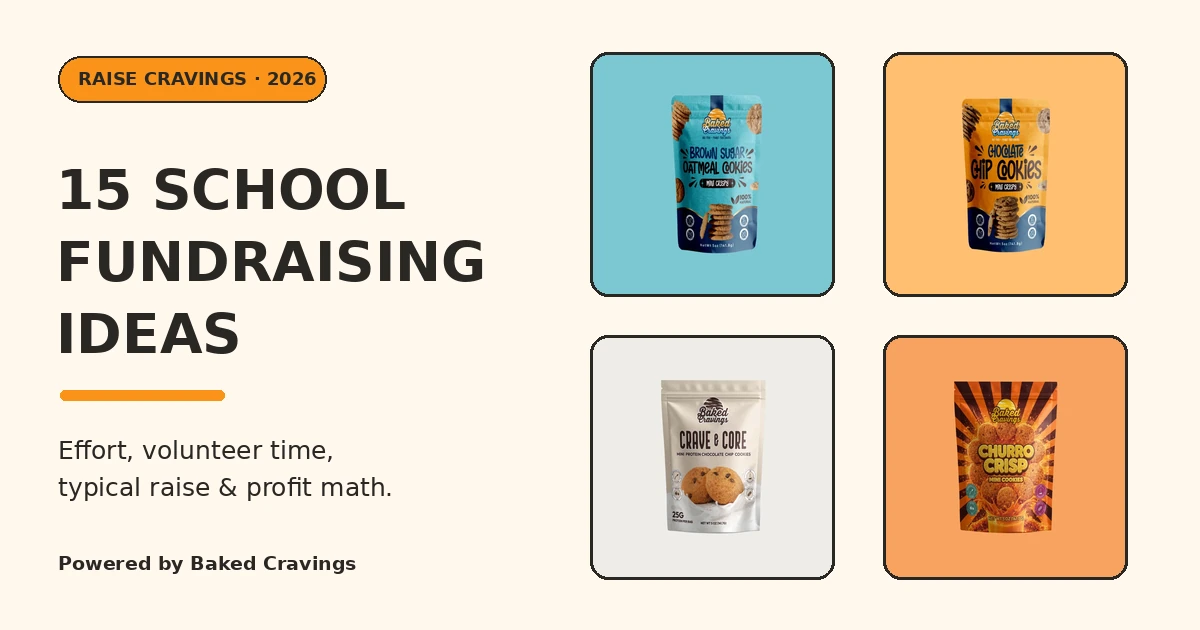
The lineup includes Chocolate Chip Mini Crisp, Brown Sugar Oatmeal Mini Crisp, Protein Chocolate Chip Cookie, and Churro Mini Crisp. For example, if 25 participants each sell 10 items at an illustrative average item price of $12, the example total is $3,000 in sales and $1,500 for the group at a 50% share. Actual earnings depend on sales and product mix.


Baked Cravings makes treats in a dedicated peanut- and tree-nut-free facility. Nut-free does not mean free of every allergen. Check product labels and your school’s allergy policies before sharing or serving any food. See how Raise Cravings fundraisers work.
4. Direct donation appeal
Effort: Low; roughly 5–12 volunteer hours · Best for: Groups with a clear goal and supportive families · Typical raise: $1,000–$15,000+
Ask families to make a donation toward a specific need, such as instruments, uniforms, or a class trip. Be clear about the goal and how the funds will be used. A direct ask avoids inventory and event logistics, but works best when messages are warm, straightforward, and easy to act on.
5. Online auction
Effort: High; roughly 30–70 volunteer hours, often over 6–10 weeks · Best for: PTAs and PTOs with donated experiences, goods, or services · Typical raise: $1,500–$9,000+
Invite families and local businesses to donate items or experiences, then let supporters bid online. School-only offerings, like front-row seats at a concert or lunch with the principal, can make the auction feel special. In 2025, the median U.S. school auction on 32auctions raised $4,030; its middle half raised $1,500–$8,900. That is platform data, not a guaranteed result for your school. Read the auction data and planning guide.
6. Nut-free bake sale or treat sale
Effort: Medium; roughly 10–25 volunteer hours · Best for: School events with steady foot traffic · Typical raise: $200–$1,500
Sell individually priced treats at a concert, game, or family night. To reduce allergy concerns, check school rules first, review ingredient labels, and clearly display product information. A commercially prepared option may make labeling more straightforward than a table of homemade goods, but it still needs a label and policy check. Nut-free does not mean free of every allergen.

7. Fun run or color run
Effort: High; roughly 25–60 volunteer hours · Best for: Schools that enjoy a big, active community event · Typical raise: $2,000–$15,000+
Students collect pledges, then take part in a run or walk. Keep registration and pledge collection simple, and budget for permits, supplies, and cleanup. The final amount depends on participation and costs, so set a net goal rather than treating gross pledges as money the school keeps.
8. School carnival or family festival
Effort: Very high; roughly 50–150 volunteer hours · Best for: Schools with a reliable volunteer team and event space · Typical raise: $1,000–$10,000 net
Charge for tickets, games, food, or activities. A carnival can bring families together, but rentals, supplies, and staffing add up quickly. Start with a small number of well-run activities and estimate expenses before setting ticket prices.
9. Restaurant or local business spirit night
Effort: Low; roughly 3–8 volunteer hours · Best for: Schools looking for a simple add-on fundraiser · Typical raise: $200–$1,500
Arrange a designated evening when a local business donates a portion of qualifying sales. Promote the date through school-approved channels and confirm which purchases count. It is easy to organize, though earnings depend on attendance and the business’s terms.
10. Student talent show
Effort: Medium to high; roughly 20–50 volunteer hours · Best for: Schools with performers and access to a stage or auditorium · Typical raise: $500–$4,000
Sell tickets and, if school rules allow, refreshments. Recruit a small team for auditions, the program, and event-night tasks. A talent show can be a strong community event, but be realistic about rehearsal time and accessibility for students who want to participate.
11. School spirit wear
Effort: Medium at setup; roughly 8–20 hours · Best for: Schools with designs families want to wear · Typical raise: $300–$3,000
Offer shirts, hoodies, or other school-branded items through a preorder or print-on-demand model. Confirm sizes, pricing, delivery timing, and the amount the school keeps before promoting it. A preorder approach can reduce the risk of ending up with unsold stock.
12. Family trivia or game night
Effort: Medium; roughly 10–25 volunteer hours · Best for: Schools with an available cafeteria or community room · Typical raise: $500–$3,000
Sell team entry, add a small raffle if permitted, and keep refreshments simple. A short, well-organized evening can raise money without the equipment needs of a carnival. Check school and local rules before including games of chance.
13. Stuffed-animal sleepover
Effort: Medium; roughly 8–20 volunteer hours · Best for: Elementary school families · Typical raise: $200–$1,500
For a set fee, students leave a stuffed animal for a supervised overnight at school. Volunteers can take pictures of the toys “reading” in the library or visiting the gym, then share the photos with families. Set clear drop-off and pick-up rules and confirm that school policies allow the activity.
14. Spirit passes or school privileges
Effort: Low to medium; roughly 5–15 volunteer hours · Best for: Schools with traditions families value · Typical raise: $300–$3,000
Sell approved perks such as hat-day passes, a reserved parking spot, or front-row seats at a school performance. Set limits and rules with administrators before offering anything, especially perks that affect safety, access, or school routines.
15. Matching-gift challenge
Effort: Low; roughly 4–10 volunteer hours · Best for: Groups that can secure a matching donor · Typical raise: $500–$5,000 added to another campaign
Ask a family, alumni group, or local business to match donations up to a stated amount. Explain the match clearly, including the deadline and cap. A match is an incentive to support an existing appeal, not a fundraiser that runs itself.
How to choose a fundraiser quickly
Before you commit, ask:
- Who will give or buy? Families, alumni, neighbors, or a wider online audience?
- How much time do you have? An event may need weeks of planning; a simple appeal can launch faster.
- How many volunteer hours can you count on? Choose based on the team you have, not the team you hope to recruit.
- What will the school keep after costs? Compare net proceeds, fees, supplies, and any upfront spending.
- What does your allergy policy allow? Ask the school before promoting or serving food, and check labels.
A simple four-week product fundraiser timeline
- Week 1: Confirm approval, choose a goal, check the school calendar and allergy policy, and assign one organizer to coordinate.
- Week 2: Set up the fundraiser, invite participants, and share a short message explaining what the money will support.
- Week 3: Send a friendly reminder with the fundraiser link. Check progress and answer questions.
- Week 4: Send a final reminder, close the campaign, and share thanks and results with participants.
For another practical overview, read why groups fundraise with Raise Cravings. If an online treat fundraiser fits your school’s needs, start a fundraiser at raisecravings.com.
Common questions
What are the easiest school fundraisers to organize?
Direct donation appeals, spirit nights, and online product fundraisers are often easier to organize than events that need a venue, equipment, or many volunteers. The best choice depends on your audience and school rules.
How much can a school fundraiser raise?
A school fundraiser may raise a few hundred dollars or several thousand. Results depend on participation, costs, and the type of fundraiser. Set a net goal based on your school’s size and available volunteers.
What is a good product fundraiser for schools?
A good product fundraiser offers something supporters want, clearly explains the group’s profit share, and makes ordering and delivery manageable. Compare fees, minimums, and volunteer responsibilities before choosing.
Are nut-free treats safe for every student with allergies?
No. Nut-free does not mean free of every allergen. Check the product’s ingredient label and follow the school’s allergy policy before sharing or serving any food.
What does no upfront cost fundraising mean?
No upfront cost fundraising means the group does not pay an initial fee or buy inventory to start the campaign. Check the fundraiser’s terms so you understand any other costs and what portion of sales the group receives.